27-Nov-2025
Chuvanna modan varity seeds were kept in cowdung water for 24 hours and sown
27-Nov-2025
Chuvanna modan varity seeds were kept in cowdung water for 24 hours and sown
I took 11 seeds of Erumakkari rice variety and put in cowdung water for 24 hours and then sown in a grow bag. This is to multiply and get more seeds.

27-Nov-2025
I keep cultivating a small variety of taro which I like very much. Wild boars don't this at the beginning, but when no other food is available, they start eating this also. When they started digging and eating, I just harvested most of it in one shot. I removed skin of some and gave to my wife for cooking, and included some mother seeds also to see if they cook well. Mother seeds are the seeds which you had put last time and they would have become a large one. But that was tasting bit itchy and does not cook like other portions. So decided to plant them back and see if they again comes up or not.

I first heard about this traditional paddy variety from a neighbor grandma whom I met during 2013 Onam Holidays. She had cultivated many traditional varieties and one of them was Erumakkari which gave good yield also not much care had to be given. The full report on this - https://farming-experiments.blogspot.com/2013/09/meeting-old-farmer.html.
After few years I talked to a farmer lady called Indira Lawrence from Kodakara,Trichur who cultivates this variety. I went and met her and collected some seeds, she had plenty of seeds and she gave me close to 250gms of this seed. I kept this seed and sown in next rainy season, but it didn't germinate. May be If I had kept the seeds in refrigerator it would have germinated, it had lost its viability. I told this farmer about this and she promised to give some seeds in the next season and I again went and collected this seed, she was around 80KMs away from my house. But this time also it didn't germinate and I was desperate and again she promised to give more seeds in the next year.
This year she sent me some seeds by post and I sent her happy hill rice seeds of Masanobu Fukuoka. This time when I received seeds it was slightly different from previous seeds, it was bit longer but she confirmed it was the same Erumakkari variety and it has awn. I germinated few seeds in a grow bag, and this time it germinated, but I thought, I should collect the more pure form of this variety. I heard that RARS of Pattambi has this seeds, so I called them and they said, they can not spare the seeds since they don't have such program to share the seeds with farmers now, earlier they used to share.
Recently while talking to a rice seed conservator called Sathyanarayana Beleri who conserves more than 650 rice varieties and has won Plant genome savior award and also Padmashree from Indian Government, I mentioned about this variety and he said he has some contact in RARS Pattambi and I could collect the seeds from there, if they agree. After few days, he told that seeds are with Faseela teacher and just tell her that Moosa sir has sent me, and seeds would be handed over. I was excited to collect seeds and started towards RARS Pattambi.
When I reached there, I called Faseela teacher and she was not in the office because of medical emergency and she would come after few hours and I told her that I will wait. While walking to the Seed Complex, an auto stopped near me and promised to take to the place since they were also going in that direction since it was a long walk, I just got in. Those were two young men going to meet scientist Moosa since I had time I also went along with them. They were there to discuss about chilli and brinjal farming in commercial scale and wanted some advice from Moosa sir. I also participated in their discussion and later told about my intention of my visit. He was very down to earth person and was very happy to discuss about many things about farming. His views were very practical and talked to him for close to 30 minutes. He was knowing about Indira Lawrence and he had a booklet of farmers who conserve traditional paddy seeds.
Moosa sir was suggesting to use Vysakh and start cultivation in May and with 'podi vitha' instead of the transplanting method I tried. Also other varieties like Swarna Modan, Katta Modan etc..
After having lunch in the canteen went and met Faseela teacher. She was also very co-operative and was discussing many things about different rice varieties. She mentioned Swarna Modan is one variety which they don't have with them right now and also Erumakkari was medicinal variety and she used that in her Phd work. Then I remembered about a lady contacting me over email about the Erumakkari rice variety and I quickly checked mail and it was Faseela teacher a Phd student then. She had identified a person called Suresh in Idukki cultivating this variety but he was not read to spare the seeds. Later she got it from NBPGR and kept seeds here.
I was so happy to get Erumakkari original seeds after a long struggle and sent half of it to Sathyanarayana and half is kept in refrigerator. I will be sowing some 10 seeds now itself.


From the fields of RARS Pattambi...some variety called Akshaya
Weed control has been very challenging and farmers use weed control mat or weed fabric etc. They use it in raised beds and also between fruit trees. It is not very environmental friendly, but some thoughts on these lines are coming to me for a short term solution.
It starts with my 0.1 acre rice field and I have been doing no-till farming on this using cover crops and later using heavy mulching using fodder grass. But it is never perfect, when I used Pureria as cover covercrop I could get good weed control, but I had to grow it for 1.5 years to get it completely established. Also after the first crop, then again weeds grow back, white clover kind of covercrop solution is not available still.
Conventionally farmers till and make a weed free ground and establish rice crop and then do couple of manual weeding. But I didn't want to till it since in principle this is my no-till field and hasn't been tilled for 3-4 years now. Anyway getting a tractor or tiller for tilling 0.1 acre is not practical.
In this context I was thinking Weed control mat for 1 month so that weeds are completely eliminated and then remove the weed control mat and keep it safe and use it for next season. In this way, should be able to use it for many years. This is just a thinking, yet to be seen if it works.
In my backyard I used tarpaulin sheet to control weeds, just to see how it goes.


I grow lot of support species for mulch creating and shade in the farm. Shade is very critical for me since the summer is very harsh and no rain season extends to 5-6 months. I have some glyricidea and have planted another 100 or so in this year. In addition to this I have moringa, mahagony, teak and few other local trees. Most of these trees I am planning to cut atleast twice in a year during the rainy season. Once the rain stops, I won't cut them any more.
Coconut buying people using to bring long poles and a special knife attached to it for harvesting coconut. I thought that will be useful for cutting branches of trees since that knife looked very robust and sharp at the same time. Found a local blacksmith and made one knife for 800/ Indian rupees and I also attach it with bamboo pole and cut branches using that. Its shape is little bit tuned for coconut harvesting so that it easily moves to the bunches of coconut. I may have to make one more adjusted to my branch cutting purpose, but it is immensely useful. The knife is tied to the pole using cycle tube piece made like a tape.

I have been trying to grow glyricidea from cuttings in large numbers this year. But success rate is very low,lots of them won't grow, it is quite dependent on the rain, may be other factors too. So this time bought some 200 seeds from amazon and trying to grow plants and transplant them. It is bit late since most of the rainy season has completed, but still trying to grow them.
26-Aug-25
The seeds are put in grow bags and they germinate in 3-4 days and growth also is good. Will transplant them after 3-4 weeks, before rain completely recedes
09-Sept-25

On this season, I was seeding rice on my no-till field, cut the grass and made a channel using a sharp tool and put 4-5 seeds at 25cm distance. Wanted to cover the seeds and had lot of compost at hand, so put compost at each seed place so that seeds were covered. This was rather an easy process to cover and each seeds have some compost so that they will get good early growth. But unfortunately rain was less during that time and ants were many, and could see lots of seeds were taken away by ants so could not establish a crop. But this gave a good learning, seeding using a drum seeder also can be done using on a no-tilled plot and later cover the seeds with compost or even cowdung. My friend had mentioned once that in Trivandrum area, rice were seeded in cowdung like this. They will take few seeds and take some cowdung and will bury the seeds in cowdung and will throw it on the ground, it was called as 'chanakathileru' meaning throw in cowdung. I felt this is an equivalent method of making seed balls, only thing is that, this should be done at the start of rainy season and seeds can not wait for long for rain. Since seeds put in cowdung may germinate soon and if rain does not happen, it may just die off. In seedball case, they will wait for rain to come and then it will germinate so will be safe. But making seedball is bit of an extra effort.


Since I don't irrigate my farm, it gets badly affected in the summer. As I see, wherever there are shades coconut trees are not affected that much. So in this season, I tried to grow as many green manure trees as possible, there are multiple intentions...
- Mulch - to feed soil and also to cover soil from direct sun and rain
- Shade - I stop cutting trees after rain stops and allow them to grow so that they provide good shade in the summer
- Liquid carbon to soil - as per scientists trees provide liquid carbon to soil organisms through their roots
I have planted Glyricedia and Acasia Siamea (Manjakonna) and Moringa in different areas. Glyricedia is planted through cuttings and their survival rate is very low, Acasia Siamea is planted by growing seedlings and most of them survived. Moringa is also planted using cuttings and they also survive well.
Even though main rain season has ended, planning to grow around 100 glyricedia saplings from seed and plant them in the farm in the remaining rainy season. I also watched some regenerative agriculture videos and in one by Byron Grower says, plant as many pioneering species as possible, suggests to plant at every 75cms and cut and mulch. This looks to be very valid, since if there is too much disturbance, we can always cut them back.
I have planted one more indigenous mango variety called Thrissurkkaran in front of the house. This mango seed was collected last year and it has been growing in the terrace for an year now. Planted and cut and mulched grass around it and there was some spoiled straw around, that also spread around it. This was found by 'Nadan Mavukal' facebook group and has been promoting it since this is a regular early bearer and a very tasty variety.

11-Nov-2025
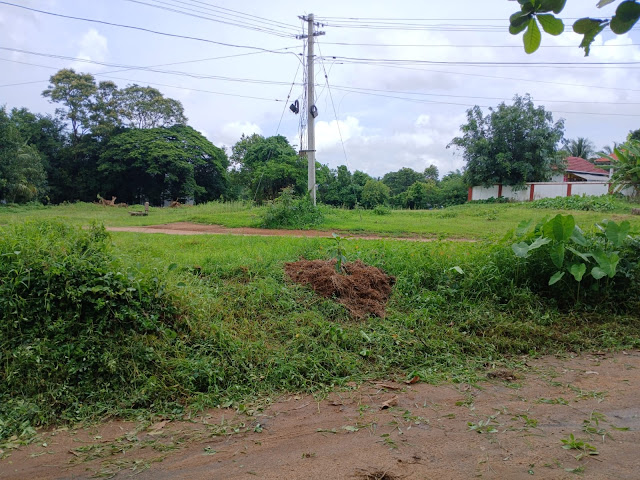
I had been growing Stylosanthes Hamata in a small patch in backyard garden. It survived summer and with rain, it established well and there were not much other weeds in that patch. Hence wanted to try rice sowing in that patch, not sure how it will compete with grass. Even after cutting it will come back and rice plants will take more time to come above. The seeds were of Rakthashali and put that in water for 24 hours and sown in the place and cut and mulched the grass.
 |


07-July-25

27-July-2025

I have a bamboo variety which is very common in Kerala and this has thorns on it. I got this saplings when I attended one session in Yuvakshethra college Mundur. I didn't realise the difficulty in managing this species when grown up. It would have been close 9 years since I planted and it grew to a big clump. Few years back, I sold it to a person who cut its small branches which will be used for making fence.
I like any biomass creating trees, but this was just difficult to cut with that thorns,cut few of the poles with chain saw, but were not able to pull out them so just left it as it is. Compared to this I like all the bamboo varieties which are thornless and easy to cut.

Recently planted Rajamalli flower plant in the farm. Seeds were collected from National High way to Coimbatore where in the middle lots of these plants are planted. This has thorns and hence are very drought resistant. In summer these plants are not seen at all and suddenly with rain they just come back. It looks like flowers and seeds has poison in it and hence has to be careful.

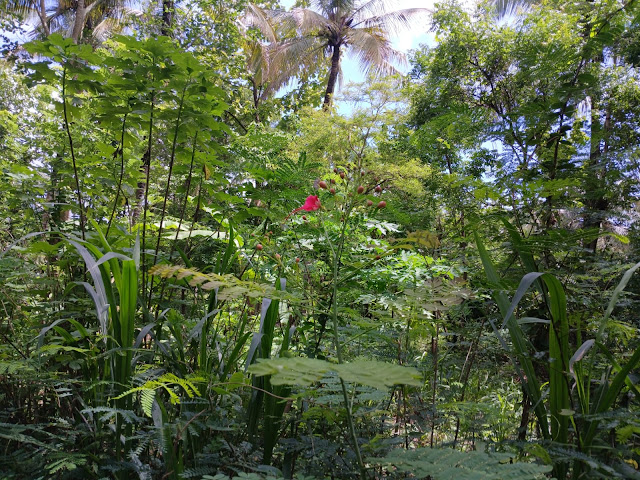
I am introducing two more perennial leguminous cover crops into the system - Hedge Lucern (locally called as Velimasal) and Stylo santhes hamata. Had tried both in the last rainy season, hedge lucern sown last time is germinating this year and it grows well. When cut many more branches comes and seeds also is formed and these germinates readily. Whether they will etsatblish quite well and will be established as a monocrop will have to be seen, that is not a preferred method.
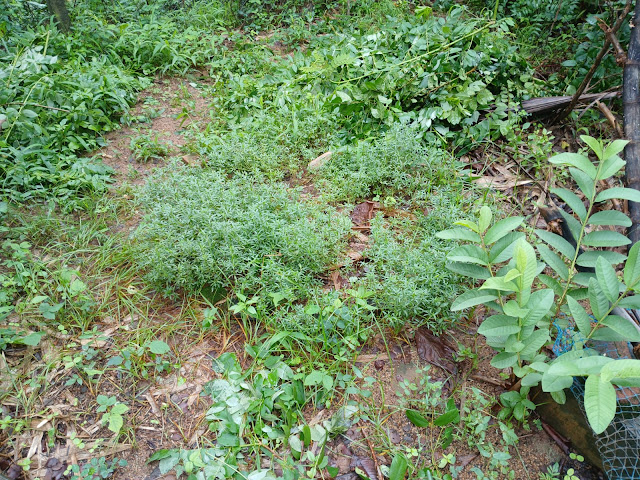
Stylo santhes hamata need much care, a small patch was done at home, that was growing well and it survived summer also. As of now, this grows to less than a feet so can be a good covercrop to grow with rice also, to be seen.

Reason for growing fodder grass is that it creates lots of biomass,in rainy season in every 3 weeks, it should be ready for cutting and it is perennial and in summer it just withers but does not turn grey completely, slight greenish color will be there. Since I don't water in summer, would like to cover the ground with a thick cover of mulch and fodder grass helps in that. Its mulch decomposes slowly also. Earlier I used to cut and collect the mulch at the base of fruit trees, now I just leave it at there.
31-May-2025

Those bunches are the fodder grass


I keep searching and using effective cutting tools for grass cutting. I have been using Scythe for long time, but now in lots of places, I have fodder grass which is bit difficult to cut with Scythe since it is very thick and strong at the base, also it is like a bunch and hence cutting with Scythe becomes bit tedious. Recently visited a tools shop in Kulappully,Shornur,Palakkad and they had a grass cutting sickle. Long handle around 2 feet and they make it from leafes of vehicles and hence they say it is very sharp and retains it.


This tool is ideal for clearing pathways and small grass.
04-June-2025

I have been looking for rice varieties which is suitable in my tilled field and also varieties for my tilled field. My major requirement is that it should survive on rain and also should compete with weeds so that weeding is minimum. Here are some possible candidates which I got from research from WhatsappGroups and talking to friends.
Mapillai Samba - This is of 150 days duration and reaches 4-5 feet height and tasty rice. Ideal for 2nd rice crop, it flowers in November and ready for harvest in January.
Kattuyanam - 6 months duration, 5-6 feet height, again people says, this is cultivated in aadi month of tamil (July) when there is flood like situation in paddy field and harvested in January. I did this one time, and it was started in June and it didn't do well
Chettadi - 6 months duration and good for 2nd rice crop also called as Mundakan crop
Chitteni - 150 days duration and good for 2nd rice crop
Chambavu - 135-140 days,150-180cm height (one person said 150cm and another 180cm), good taste, good tillering. One person called Prabhavathy confirmed that she had tried Chambavu for 1st crop,May 15th seeds were sown and transplanted in June and harvested by September last.
Yet another person Sasidhararan Master had tried this in 1st crop, he started in June mid and harvested in October, 120-130 days. It was tall, a person standing in the paddy field won't be visible, tasty rice.
Talked to another person called Santhosh in Palakkad who has been doing Matta Chambavu for many years. According to him, duration is 120 days and height will be minimum 4 feet, not much tillering..it may fall, tasty rice. Starting in June may be difficult for 'podi vitha' since it may rain soon heavily and field may be submerged in water, transplanting may be better.
Kayama - 150 days duration, 4 feet height,tasty rice, competes with weeds well.
Attappadi Upland Rice - According to Durai Swamy of Attapadi, this is sown in Karkkidakam (July-August) and harvested in Vrischikam (November-December). If it is sown early it may reach more height. I tried this once in June and it reached good height, more than 4 feet, but grains didn't form, lots of rice bugs were there, may be because of this or timings was not proper.
Planning to try Kayama this time, Vinod from Nallabhoomi has promised to send the seeds.
26-May-2025
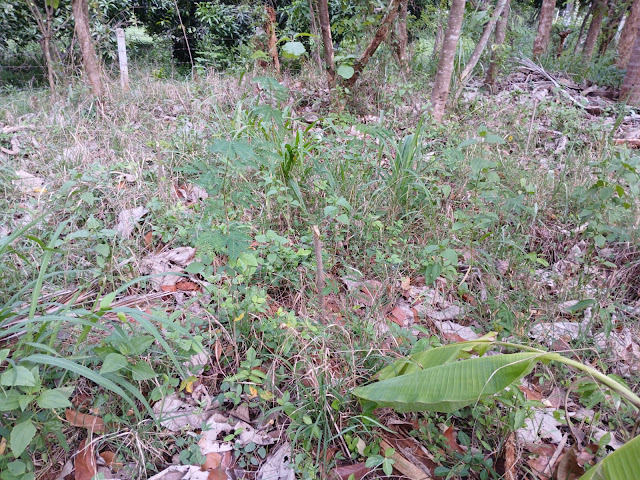
I had kept few happy hill rice seeds in refrigerator, 100 seeds kept outside for 2 days and then sown here. I had mulched and kept this area in summer, also had applied some compost and cowdung. If there is sufficient mulch we get good weed control, at the beginning of monsoon. If area is left uncultivated, within no time, weeds take over. It is better to start rice at the beginning of monsoon, so that weeds hasn't germinated.
Made a channel using locally made fokin hoe put 2 seeds at around 20cm distance and later covered with soil.


Jackfruit trees are also shading this region, hence cut few branches
14-June-2025
It didn't rain for 10 days, and not much seeds germinated. Hence again levelled the place and put 300 seeds this time, could see why in broadcasting farmers always put more seeds. The seeds were put in water for 20 hours and brodcasted.
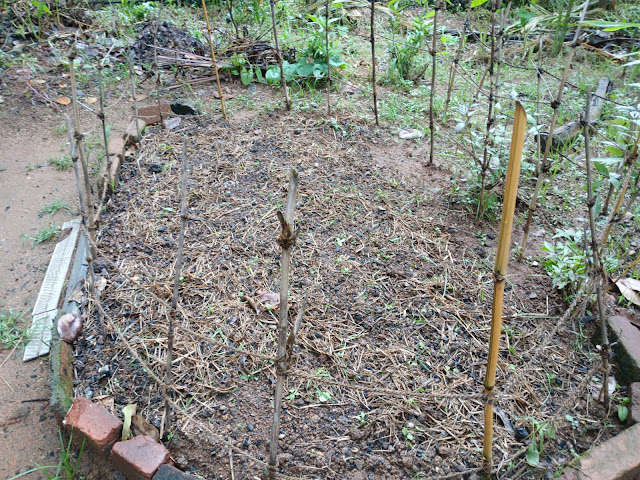

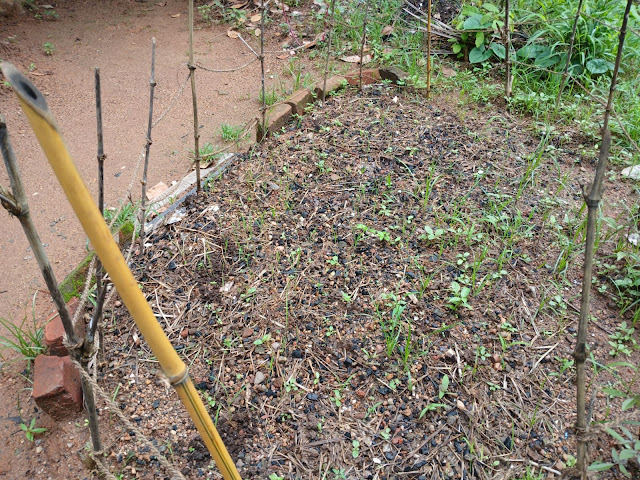


In coconut area, wanted more shade in the summer. Thinking of adding multiple ever green support trees for this, one being Glyricidia. We got a good summer rain, just wanted to check if Glyricidia can grow in pre-monsoon shower.