Monday, October 14, 2013

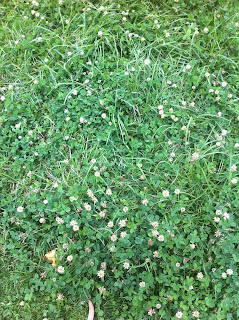
White clover in Kodaikkanal

Fukuoka san had used while clover as a leguminous cover crop for grains and for orchard. He had choosen aftr experimenting with many other cover crops. For grain farming he used to sow the clover seeds with grain and white clover remains at the ground level while the grain grows high. If he feels that while clover is blocking sun light for grains at the initial stages, he used to flood the field which weakens clover and grain grows well during this time. Once the grain is established he drains the water so that white clover remains at the foot of the grain, which fixes nitrogen and also avoids grass.

Like many I was also searching for white clover when I started natural farming. But couldn't get the seeds of white clover. Later many suggested that it won't grow in kerala climate, so just left it. Later one friend in Japan sent me some seeds of white clover and tried it in different seasons but couldn't see it germinating.

Couple of days back, went to Kodaikanal with family/friends for a two trip. On reaching the hotel Stonycroft, I was really surprised to see white clover in the lawn. It was reasonably established in some parts and later found that it in road sides and other parks also. I had checked its name with couple of local people, but they never knew its name. Kodaikkanal being a hilly area has a very cool climate and that may be the reason why it grows there. I liked its feature,it is very low height and establishes well in the grass.

Here are some pictures


Tuesday, October 1, 2013

Rice farming - Season 2 - 2013

For season 2 (Sep-Oct to Dec-Jan) also, I am going for tilled organic farming since one area of the farm. Doing no-till farming for this area is not possible since there is heavy grass in the area. In my observation, if there is already grass established, there is no way you can establish another grain crop which is also a grass variety.  So I am planning to use cow dung and grass grown in that area as manure and doing rice.

I tilled the land on Sept 14 after flooding the area with water. The tiller was used for around 3 hours and he charged me 700/- for this. Since there was lot of grass, it took this much time. I put Vysakh (upland rice) in one part of the field after draining water from this on 21-Sept. I had put the seeds in water and removed all the floating seeds to get the heavy seeds so that seedlings will be stronger.

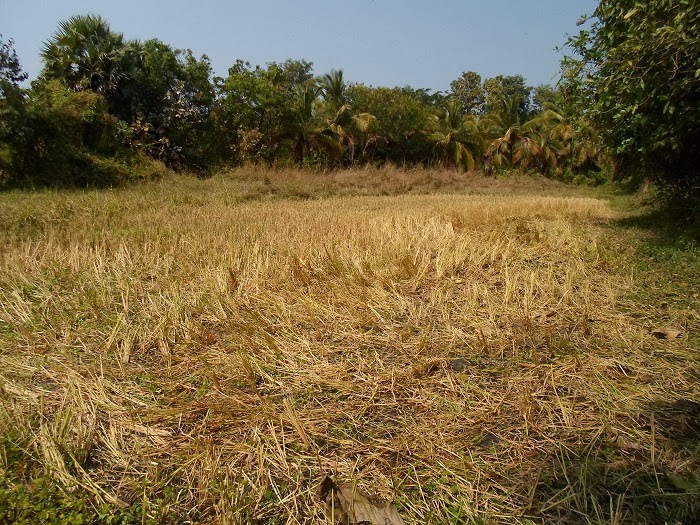
Field after preparation.


Rice seedlings coming out.


October 31,2013
Initially after transplanting seedlings were having a yellowish colour, now they are turning more green. Twice a week, field is flooded now.


November 13,2013


In some area, plants are little weak. In one area where I had dumped cowdung in the last season, plants are more taller 

December 16,2013


flowering started ..it hasn't reached full height (4 feet) as earlier. 

Felt extremely happy about getting a harvest - Peacocks didn't take much..and insects were less with Vysakh


Harvest completed on 18th Jan 2014 - Got around 40Kgs of paddy..Paddy was boiled and dried for 3 days and took to a rice mill. Got around 23Kgs of rice, it cooks well and very tasty, even children liked it much


Straw was put back after broadcasting cowpea


Wednesday, September 25, 2013

Sunhemp and velvet beans

This year I planted sunhemp and velvet beans in June with monsoon start. I broadcasted the seeds and then cut and mulched the grass and it has grown well. Once it produces seeds, I will collect it and will cut and mulch it.


Sunhemp

Sunhemp

Velvet beans

Wednesday, September 18, 2013

Meeting an old farmer


During this onam holiday when I went to my native place, I happened to meet this neighbour grandma. Earlier she and her husband was living in a farm adjacent to a forest area and later when they grew old her husband sold that property and they moved to stay with their kids. Her husband expired couple of years back, and she was alone.


From he talking she was missing her farming way of life which she enjoyed a lot. I just asked her what all cultivation they were doing. To my surprise, they had cultivated a number of indigenous paddy varieties. I could collect some details from here and putting it as it is.

Erumakkari -  gives good yield


Vattan -


Chembavu


Pal chembavu -  and porridge made using this tastes like milk


Thekkan Njali


Athiyan - It is red rice


Vellodan


Masoori - good yield


Chitteni + Pazhanikkutty - This is used in doing 'Koottumundakan' in which two varieties are sown together


Navara - 60 days


Karamkari - 60 days


Athiyan pattambi


Cheera


Ettikandappan


Komban
Some other information which she shared with me..


If soil has lot of 'poozhi nayakam' then no need of any fertiliser..poozhi nayakam can be seen when we take the soil, it seems like this is not earth worm..and its casting can be seen through out the field


In 'Potivitha' they plough using bullocks and sow the paddy seeds in April 15th when usually the first rain starts. There will be lot of grass but  they just cut the 'kathiru'.
They do 2 cultivation, second cultivation using water from the streams which comes from forest. Later people started planting rubber etc.. up hill and streams stopped..


She had lot of cows..upto 60 in one time..they dump lot of cowdung into the field along with leaves..during harvest it will be mud upto the knee..


She gets up early and go for walk..and comes back by 7 o' clock..and she loved that life..but her husband finally sold the property...and she still misses that life...


9-Nov-2014
Yesterday, received a call from this grandma's daughter she informed that, grandma passed away. Last time during our visit to my native place, myself and wife had visited her. May her soul rest in peace.


Wednesday, September 11, 2013

Some paddy experiences from others

I am planning to start 2nd season paddy crop this year and was discussing this with a neighbor. On this season, I was planning to get a tiller and puddle and make muddy field and transplant the seedlings. This neighbor is around 70 years and he is a traditional farmer and has more than 10 acres of paddy field and does two crops yearly. On hearing about my paddy plan, he asked me to delay the planting since the neighbors hasn't started planting yet. He told me that if my paddy gets matured first all the insects will be coming to my field, so it is better that I time it with other neighbors so that insects will have lot more area to attack and hence per unit area attack will be less.

I have heard about similar comments from others that if the rice gets matured and there will be parrots and peacocks coming for the harvest and if your paddy alone is there, the attack will be very severe. So when the area is more, birds attack severity will be less.

Even if we do natural farming or not, these things are important since insects/bird attack will be there anyway.

Monday, August 26, 2013

Peacocks in the farm


There are lots of Peacocks in the farm. Some time when I walk to some part of the farm, I hear some walking sound, later find that it is peacocks. Some time as I approach some mango tree, they just fly. They are a protected species so their numbers have increased..

Some pictures


11-June-2019

Today while walking in the farm, suddenly a peacock flied away, just looked around and saw 4 eggs she had laid. This is not in a far place and may be easily spotted by people, so planning to cover it slightly.