Tuesday, June 21, 2016

Farm in start of rainy season - 2016

This time summer showers came towards may 2nd week and monsoon started around on June 6th. But heavy rains are still missing in Palakkad, while in southern parts of Kerala there is good rain.


Weeds cleared using Scythe, this area still need more interplanting..only a few glyrecedia's exists...


Cocoa and glyrecedia...


Banana circle, this one is doing good..


Cocoa, papayas and mango tree...this mango is having excellent taste...don't know the variety


moringa cutting coming up very well...

Mango variety Neelam...this one comes very late and ripens in rainy season...but no worms, tastes good


Wednesday, June 1, 2016

An interesting rice cultivation experiment

The article about this rice experiment came in a magazine called 'Ore Bhoomi Ore Jeevan' (One Earth One Life), which is a monthly in Malayalam for environmental conservation.

Article was written by an organic farmer K.Basheer, Sujeevanam, Mannarkkad,Kerala. He came to this observation when they were cultivating  a traditional variety of rice called 'Cheru vellari' in Abhayam, a charitable trust run by Mr. Krishnan for old people.

They got the seeds of 'Cheru Vellari' from Malappuram. It is a red rice, with 120 days of duration and reaches a height of 3-4 feets. After the first crop when there were going to till it for next crop, they saw rice is again growing from the left over. Then they just left it and applied some cow dung and they got a very good yield from the 2nd crop than the previous one. First time it was around 1600Kgs of paddy.

After this crop, they left all the straw back and observed that rice is growing back again and they left it as it is and got a good yield again.

They are at the 5th crop now, and after the rain the rice plants are growing, has to wait for another 3-4 months to know the results.

It says that, lot of traditional rice varieties has this property of ratooning and we can get another crop from the previous one.

Some photos taken on 19-June-2016


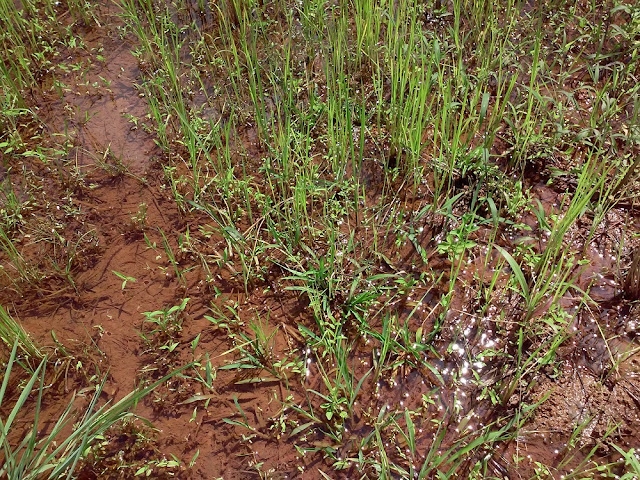
There is regrowth from previous cut plants and also there are new plants from fallen seeds


18-Sept-2016

Today met Basheer master in a meeting and asked him about the ratoon cropping and it looks like, the rice didn't establish well on this season and hence they ploughed and started a new cultivation.


Weed clearing using Scythes and Billhook

Pre-monsoon showers started in May 2nd week, temperature came down and land has become wet. Monsoon will start any time now and it is hectic planting season now. Weeds are emerging every where and cover crop Pureria Javanica also is growing very well and climbing every where.

I used to use grass scythe earlier, which is quite good for grasses but its edge gets damaged quickly on hitting thick stem bushes. Then I bought a bush scythe, but that can not cut grass effectively. Then there are cases when creepers go all around the saplings and cutting them need a Billhook, using scythe for that job is not good, since it may cut the saplings. While starting, I use Scythe so that when there is a disturbance if there are snakes, they will move from the place, Scythe with long handle gives a comfort feeling.

Now I carry both grass scythe, bush scythe and billhook and select the right one depending on the requirement. This is becoming an effective combination in my case.


The one with metal snath is bought from Anant Chaturvedi,Kanpur,India.


2-June-2016

Weed clearing done on 3 different places...mulch is put around young cocoa saplings


If any one would like to buy a Scythe in India....Please visit the site http://www.scytheindia.com/

Tuesday, May 24, 2016

Happy hill rice - 2016 monsoon

Happy hill rice was cultivated by Masanobu Fukuoka and supposed to be one of the best yielding variety. On this monsoon, I am cultivating happy hill rice just to make sure that I have the seeds..and probably try to improve this variety for the local climate. The seeds which I am using now, is cultivated from the original seeds sent by a Japanese friend.

A raised bed was made and cowdung is spread and some seeds were put directly here. Some seeds were kept in a covered wet cloth and after 3 days, they started germinating and those seeds were put in another portion of the raised bed.

I hope to send the seeds to more people who is interested to try out this variety. Last time I had sent the seeds to 4-5 friends located at different parts of the world and had requested them to send back some seeds after their harvest, yet to hear from them.


25-May-2016

Rice seedlings can be seen....


2-June-2016


10-June-2016


Just made some aeration for the soil using a stick and poured some cowdung slurry. Arachis pintoi planted along with it, just to see how it grows along with paddy.

24-June-2016


7-July-2016


15-July-2016


Rice plants looks beautiful now !!! Application of cowdung slurry does all the magic...I apply it once in 2 days, since cow shed is nearby...flowering started...

24-July-2016


1-August-2016

More flowers and grain formation stared....taken using iPhone


11-Aug-2016


Grains are turning yellow, getting ready for harvest

27-August-2016

Harvested a portion of the paddy....some grains are still green...some good plants with many tillers haven't flowered, may be lack of light...cowpea which was grown neaby has taken some light...


My daughter counted the grains...counted one bunch and then multiplied..70 bunches and each one containing 160..totally 11200 grains...this is not complete harvest..Total number of seeds used was around 50.

Tuesday, May 17, 2016

Broadcasting horse gram, cowpea and sesame in harvested rice field

After the harvest of the rice was over by mid March, I scattered horse gram,cowpea and sesame seeds,mulched with straw and then  irrigated. Ideally it should have been broadcasted 2 weeks before harvesting, but since walking through the muddy field was difficult, postponed it to after harvest.

By the time, harvest was over field had gone completely dry and even cracks started developing. Cowpea and horse gram germinated well,but sesame was not seen at all. It looks like field was completely dry and sesame didn't germinate well. Even though it was irrigated, climate was very hot and goes dry very fast.

Later some time, could see some sesame plants also in flowering and fruiting stage and it was never over grown by weeds. There were not many fruits, but considering the fact, no manure was applied and field was just recovering from previous till operation, it was fine.

So if timed well, no-till way of sesame,horse gram and cowpea may work out and will be tried in the next season.


Monday, May 9, 2016

One farmer who talks about pelleted seeds,cover crops,no-till grain farming with clover etc..

Came across the blog of Eric Koperek who has extensively used pelleted seeds,cover crops and no-till grain with clover. Please see the site, it has wealth of information. Had some email communication with Eric and came to know that he had visited Fukuoka in 1972 and 1980.

https://agriculturesolutions.wordpress.com/

Some interesting information taken randomly from this site...For complete information, refer the above site...

Biological No-Till Small Grains:     Broadcast seed pellets by hand or use a rotary spreader.  Sow pellets directly into standing vegetation so that soil remains undisturbed.  (Broken soil stimulates weed germination).

2 to 4 weeks before harvest sow pelletized seed of second crop into standing vegetation of first crop.  This is necessary to control weeds.

TO CONTROL WEEDS IT IS ESSENTIAL TO KEEP SOIL COVERED WITH GROWING PLANTS AT ALL TIMES = 365 DAYS YEARLY.  USE CLOVERS OR OTHER COVER CROPS TO FILL UP EVERY DAY OF THE GROWING SEASON.  SOIL SHOULD NEVER BE LEFT BARE, NOT EVEN FOR A SINGLE DAY.

Before seeding clover or any other living mulch, remember that two crops are growing on the same land at the same time — the mulch crop and a cash crop.  Success requires careful management or both crops may fail.

Costa Rican Indians grow dry beans by broadcasting seed into the weediest fields available.  The weeds are then hand cut and left as mulch to protect the germinating beans.  Yields are low, only 400 to 500 pounds per acre, but there are no costs other than labor for planting and harvesting.

Direct seeding into standing clover is not recommended unless the clover is knocked back to reduce competition with the primary crop.

Seeding small grains into living mulches works best when:  (1)  The companion crop is dormant or its growth retarded by mowing, grazing, or rolling, and  (2)  The grain crop is selected for a competitive growth habit.  Heirloom (non-dwarf) varieties usually pair well with understory legumes like Dutch white clover.  Alternatively, clover can be broadcast into standing grain that is well established (8 to 12 inches high).  Again, careful timing is essential to prevent the cover crop from overwhelming the cash grain.

The key point to intelligent weed control is to disturb the soil as little as possible, just enough to get a crop into the ground.

Remember that weeds have evolved specifically to rapidly colonize bare soil.  The more soil is tilled, the more weeds are stimulated to grow.  
Down the road I have a wilderness of citrus interspersed with live oaks, Spanish moss, and pangola grass.  It’s an old orchard that is long overdue for rotation, but it still makes me money because I spend almost nothing to maintain the trees.  Every now and then I spread some racetrack manure.  The irrigation system turns itself on and off.  The weeds grow 6 feet high.  Once a year, right before harvest, I mow between the trees — just enough so folks can pick the fruit.  Result:  No bugs on my trees.  Across the hedgerow of old-fashioned hibiscus, my neighbor clean cultivates his orchard and sprays with robotic frequency.  Every spider mite in the district comes to eat his leaves.  Chemical companies use his orchard to test new pesticides.  The mites don’t seem to mind; they eat insecticide like salad dressing.
Across the lane is my pride and joy: A jungle of weeds and melons.  The weeds grow over my head and the melons grow over the weeds.  The trick is to mulch the young melons (or mow the weeds) just until the vines start to run.  After the melons are well established, the crop fends for itself.  Vine crops thrive in the light shade cast by nearby weeds; the best fruits come from the weediest parts of the field.  Insect pests don’t like the broadleaf jungle so I never have to spray vine crops grown in weeds.
Find the weediest field possible.  Broadleaf weeds are best and thistles best of all.  (Thistles indicate fertile soil).  Broadcast seed directly into standing weeds.  (Pelleted seed greatly increases seedling survival, especially for large-seeded crops like peas and beans).  Mow down weeds with a scythe (or use a lot of people with sickles or machetes).  Cut weeds act as mulch for germinating crop.  Pray for rain.  Come back at harvest time and hope for the best.  Yields are low but surprisingly economic (because there are no costs other than seeding and harvest).


Saturday, April 9, 2016

Summer - 2016

Summer is hot and temperature is at 40 degree and no summer rain yet. Neighboring district Trichur received good rain and it is still raining from morning there. Open well is almost dried and pond used for irrigation is also in the same state.

Some views...


Earth worm castings...it is there throughout where cows does not graze...


Rice field with horse gram grown after paddy harvest...field is mulched with straw, but does not cover the whole field densily


Papayas stopped yielding...but still there are some fruits left


Only some water is left...5 families collect drinking water from this well.. Some small fishes are there and one king fisher is constantly behind them...


Termites are attacking healthy trees also..but no harm done..


Termites do a good job...


Banana circle...


Tapioca growing on Hugelkulture beds..they survive without any water...


Effect of summer heat..some plants just fall down


Termites


Hugel beds opened up during tapioca harvesting...


It is mango season...


Some more banana circles....


Water does not reach here, no grass seen