For this season, I tilled the field even though in natural farming tilling is not done. After couple of failures without tilling, in this season I thought of doing tilling to control weeds and once I have sufficient mulch, planning to do no-till in the next season. Also in this season I had collected three traditional varieties of paddy namely - Chuvanna Modan, Kalladiaryan and Thavalakannan. In the above Chuvanna Modan and Kalladiaryan are upland rice, which is typically cultivated in the upland area where there won't be any standing water.Another variety is Vysakh which is a high yielding upland rice.

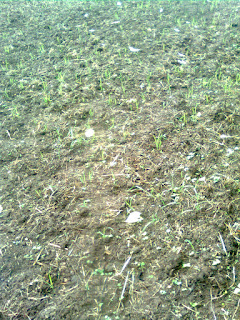


July 29,2012
Grass has grown in some places and overtook the paddy. I wanted to do weeding, but it looks it is little late since grass has grown thick, now pulling is not easy..and thorns on the touch-me-nots are strong and it hurts. So without cover crop, I shouldn't have tried this. Earlier I was thinking, if paddy grows well, then grass may not be a problem, but if there is a gap, grass will grow and they grow much better than paddy. In one side of the bund, there is a subabul tree and saplings of this tree is growing under this, very thickly. But in this place, paddy has grown above it, so it does not look like a problem, I would have used Subabul as a cover crop??
The two photos below are weeded by women and they make it like a ground, pulling and removing all the weeds. I did one part by myself just by cutting the tall grasses and asked them to do that way.


Aug 11, 2012


Sept 02, 2012
Rice has come over the weeds now..but still there are more gaps between the plants and hence peacock can be a threat since they can easily walk between the plants. Some of the plants started flowering


 Sept 9, 2012


Since seeds were limited, I just dibbled the seeds at a distance of around 10cm. Dibbling was done using sickle and initially I had put 2 seeds, but later my helper told to put 5 or 6 seeds and I was little hesitant for it so went for 3 seeds at one point. This is the first time I am trying dibbling, so the lack of experience showed up. I was careful so that the opening made with sickle is not deep so that germination is good. Also earlier I had experienced with transplanting that if distance is more, weeds will come in the free space and it is difficult to control.
Even after all the precautions, what didn't work was bad germination and gap between plants became more because of no germination. Some lessons...
1. Sowing was little late and was done when the rain had actually started. From the earlier experience I had seen that when the rain is heavy, germination is bad. Typically farmers do sowing along with the first rains which is probably we should do
2. Number of seeds at one dibbling point should be more, may be 5 or 6 seeds. In this case at least one two atleast will germinate. Even if all germinate later removing is still OK, but if none comes at one point, the gap becomes more
3. Be prepared for low germination and make a back up plan, by making a nursery so that at points where it does not germinate, plants can be transplanted
Here are some photos...


July 29,2012
Grass has grown in some places and overtook the paddy. I wanted to do weeding, but it looks it is little late since grass has grown thick, now pulling is not easy..and thorns on the touch-me-nots are strong and it hurts. So without cover crop, I shouldn't have tried this. Earlier I was thinking, if paddy grows well, then grass may not be a problem, but if there is a gap, grass will grow and they grow much better than paddy. In one side of the bund, there is a subabul tree and saplings of this tree is growing under this, very thickly. But in this place, paddy has grown above it, so it does not look like a problem, I would have used Subabul as a cover crop??
The two photos below are weeded by women and they make it like a ground, pulling and removing all the weeds. I did one part by myself just by cutting the tall grasses and asked them to do that way.


Aug 11, 2012


Sept 02, 2012
Rice has come over the weeds now..but still there are more gaps between the plants and hence peacock can be a threat since they can easily walk between the plants. Some of the plants started flowering


