Monday, February 17, 2014

Amazing natural farm of Masanobu Fukuoka


Amazing natural farm of Masanobu Fukuoka
----------------------------------------
Here are some photos of amazing natural farm of Fukuoka. These photos were given to Raju Titus of Hoshangabad,MP during Fukuoka's first indian visit. Not sure,how does the farm looks now.

Fukuoka had rice,wheat,rye, mandarin oranges and vegetables. He didn't plough his field and applied straw and chicken manure as fertilisers. There was no need for any insecticides and his rice field was one of the top yielding.

Fukuoka had cultivated happy hill rice which he had developed in his fields. According to Fukuoka, "I have created, together with the insects in my fields, a new strain of rice I call "Happy Hill". This is a hardy strain with blood of wild variants in it, yet it is also one of the highest yielding strains of rice in the world. If a single head of Happy Hill were sent across the sea to a country where food is scarce and there sown over a ten-square-yard area, a single grain would yield 5000 grains in
one years time. There would be grain enough to sow a half-acre the following year, fifty acres two years hence, and 7000 acres in the forth year.This could become the seed of rice for an entire nation. This handful of grain could open up the road to independence for starving people".

Fukuoka cultivates Rice from May to October and Wheat from November to May, basically two grain crops which takes the entire year so that there is no gap between crops. It is important that there is always crop in the field, so that weeds does not get a chance to comeup. Some weeds are OK, but it should be minimal.

In early or mid-October, clover seeds are sown over standing heads of rice, then about 2 weeks before harvesting rice, Barley/Wheat seed is sown. White clover is used as a leguminous cover crop which enriches soil with nitrogen and also checks the weeds. Being leguminous white clover can be controlled by holding water in the field and this weakens clover but does not affect rice/wheat/barley which belongs to the grass class. Sowing Barley/Wheat before harvesting of Rice is very important since it allows the Barley/Wheat to germinate early so that weeds are held back. If Barley/Wheat is sown after harvest, then weeds also will be germinating along with Barley/Wheat. Once the weeds are established controlling them is difficult. Also the most care is needed for crops at the young stage and at this stage if there is competition from weeds, then crop will affected badly.

Similarly rice seeds in clay pellets are sown over the wheat/barley before harvest along with white clover.

Fukuoka cultivated orange with just using white clover as leguminous cover. Vegetables also were cultivated in the orchard.

From the photos you can find that it is an extremely productive farm, even though there was no-tilling, no-fertilizing, no-weeding and no-insecticides.


Wednesday, February 5, 2014

Traditional rice varieties

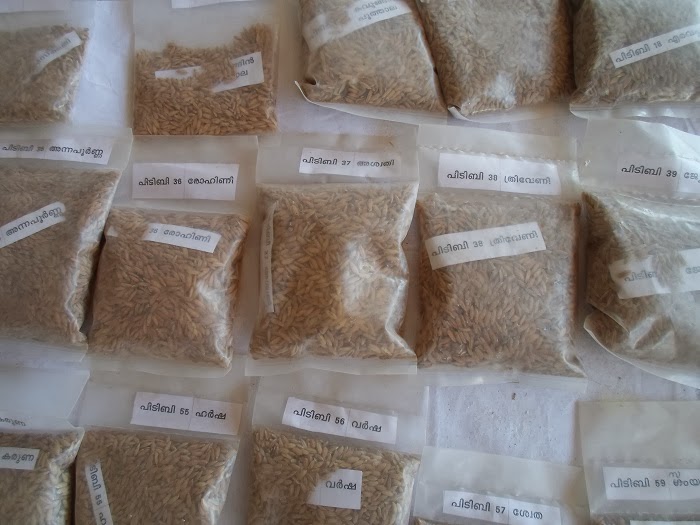
Recently visited an exhibition called 'Polima' which was held in Palakkad,Kerala. There was a display of traditional rice varieties here. Some of these are cultivated now, but not all. There were many rice rice varieties available in Kerala. I used to wonder why there are so many varieties, it looks like people used different varieties depending on the climate and for different purposes - for example upland varieties were developed for cultivating in upland just depending on rain water, and there were a set of medicinal varieties. There were popular vaieties in each area and farmers in those time preserved all of these.

I don't have a very clear picture of how these new varieties were developed. Some information on this..for example, during cultivation, if farmer find some new features of rice, for example some rice with black colur, they use those seeds separately and cultivate and some will exhbit this new feature. Again selection will be made and cultivated and after some iterations (which takes many years - 5 or 6) a pure breed with black in colour will be developed. Prakash Raghuvamshi also explains this method in his videos, where he had developed taller varieties and high yielding varieties. See some of the varieties developed by him..


At that time since most of the people were involved in farming, they were completely focussed on these activities ..as part of green revolution, new hybrid varieties were developed, and farmers started using this for high yield, but they needed high inputs also and hence more water. They were short and there was
more competition from weeds and weed control became an issue. Agriculture departments started giving seeds and farmers stopped conserving varieties and cultivation was done using only a couple of varieties. For e.g in Kerala, most of the cultivation is done using hybrid varieties - Uma and Jyothi.

In the exhibition, I asked the person about a list of these varieties, they were not interested in giving that. They said, this is just for show, these varieties are not cultivated now, I couldn't see the respect for these great varieties developed by our ancestors. But there are a number of people who is interested in
cultivating and spreading these traditional varieties and hope there will be more people interested in doing it.

Some photos...


Monday, January 20, 2014

Visiting farm of Tony Thomas

I have been visiting many farms now a days, and from each farm visit I learn some thing new, but it looks like still a lot remains to be learnt.

Today visited farm of Tony Thomas who has been working in the 'Kerala Jaiva Karshaka Samithy' (Organic farming association) for many years (More than 20 years). This is the group which spreads the message of organic farming, ecological conservation in Kerala. Kerala Jaiva Karshaka Samithy has a magazine called 'Ore Bhoomi, Ore Jeevan' (One Earth One Life) and Tony Thomas handles the legal section of this.

His farm is in Irumbakan chola, Palakkad,Kerala and is around 25 acres. Farm is surrounded by forest and on one side we can see Kanjirapuzha dam. He cultivates rubber, coconut, arecanut, pepper, coffee, bamboo, tapioca, ginger, turmeric, kachil (creeper with fruits) and many fruit varieties - mango, jack fruit, fig, lemon..There is threat of wild pigs, peacocks, and monkeys. He maintains an electric fence and he says it has to be inspected often so that there are no grass or plants touching and earthing it. If it is maintained this way, it is very effective.

He has 9 vechur cows and 2 other local varieties of cows. When he started organic farming, there was no one to guide. Initially he had 25 cows and after their grazing, all top soil got washed away. He says, probably 5 cows will maintain a good balance for 25 acres. If number of cows increase, fertility of land will be affected. Initially he made a compost pit and it was too deep and because of lack of air, composting was not happening. It looks like he has learnt many things in the hard way.

He says, water/soil conservation is very important in farming. He digs small pits so that rain water goes here. During heavy rains, he just walks around where ever there is water overflow, he makes small pits.

In his coconut farm, earlier he had arecanut and he says both the crops are of same type and their roots also lies in the same level and hence they compete each other. Later he cut arecanut and planted trees (moringa, mango etc..) and according to him after this harvest improved. The trees bring many micro-nutrients from deep layers and it becomes available for coconut. If the trees grow too big, he cuts the top, typically in every two years.

He also has many herbal plants and he says mulching using these herbal plants keep the insects away.

He has planted ash guard, pumpkin here are there and leaves it unattended and they cover the area, and he also gets some vegetables this way.

I was happy to see the Arachis Pintoi (Perenial peanut) or Kattu kappalandi (in Malayalam) in his lawn. Apparently this is being experimented, in some research organizations as cattle feed.  I was planning to use this as cover crop in my fukuoka style no-till rice.

Here are some photos...


Arachis Pintoi - used as cover crop and also in lawns


Tapioca - mulched using arecanut


Turmeric


Coffee

Pepper

Lady's finger


Dr.Sudhodhanan's class

Way to the house

Tony Thomas about his farm

Air Potato

Vechur Bull/Cow


Vechur Cow