Sunday, January 27, 2019

Planting Ayurjack Saplings

21-January-2019


Some time back had visited a farmer called 'Varghese Tharakan' in Trichur who had done a wonderful rain water harvesting in his hilly farm. He had made deep trenches against the slope and directed all the rain water to these trenches. He had planted rubber saplings throughout this farm and also bananas and without any drop of irrigation he could harvest banana and his rubber trees grew well.

Then we hear the news that he cut all the rubber trees and banana and planted a special variety of Jackfruit tree which he named 'Ayurjack'. He discovered this jackfruit tree and it was very tasty and hence propagated it using budding and it gives fruit in 1.5 years. He realised its potential and planted around 1000 jackfruit saplings. Some of his trees have fruited and it looks fascinating and he became famous. He runs a nursery of jackfruit saplings and sells it at rupees 500 onwards and big saplings costs 1500 rupees. Whether this is same as popular Vietnamese early gold jackfruit, not sure?


I visited his farm with my friend and bought two saplings for 600/ rupees each. Even though I am not a fan of budded trees, thought of trying it out. Took around 2x2x2 feet pits and filled with dried cowdung and neem cake (little bit) and then planted it.

Some youtube videos about Ayurjack jackfruits

https://www.youtube.com/watch?v=GyJIglaZF8M

https://www.youtube.com/watch?v=WaV1efggyLI

https://www.youtube.com/watch?v=JLqz7C9rheI


19-January-2019

Ayurjack saplings in my backyard


05-Feb-2019
There are some debate happening whether the Ayur Jack is Vietanamese early or not. Here is some video which explains some findings, it looks like it is Vietnamese early Jack fruit.

https://www.youtube.com/watch?v=WQagnwbNmdo&feature=youtu.be


14-Feb-2019

A recent report which came in news paper about the Ayurjack issue


07-March-2019


29-August-2019


06-October-2019


28-November-2019


26-June-2020

After the rains, they are picking up


10-September-2020


Add caption

16-April-2021


One tree started fruiting...


26-August-2021


One branch fell off, hence cut the top..can see small jackfruit coming up


Jackfruits started growing..3 are there in one bunch


20-Sept-2021

It completed 2 year 8 months..fruits are growing OK, even though small..


Making sure that fruit is ripe on the tree itself...as per one person, only one should be allowed in a bunch, others should be removed so that they can be used to make curry

10-October-2021
---------------------

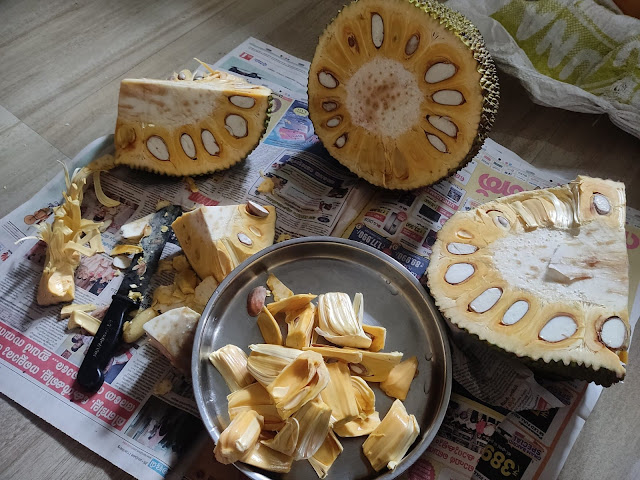
Finally harvested it, yet to ripe and taste. This didn't ripe well.
14-January-2022

Got one more jackfruit, this time harvested it after it was ripe on the tree, smell is very sweet after ripening


It tastes sweet and good

18-01-22

Got one more ripened jackfruit...sweet smell was coming and then plucked it, tastes very good


12-July-2022


fruit got in rainy season was not good, better to use them in raw form as vegetable. Now small ones are being formed..

07-October-2022


Gave few young jackfruits to neighbours and we also used some. Today sold few of them to a vegetable vendor and it was 7.5Kgs and they took it at 50/- per kg, that was a decent income. Few bigger ones were rotted and lost it, may be because of rain.

9-November-2022


Got one fruit, taste was not that good, may be because of the rains..

06-Feb-2023


Got two more,taste was not upto the mark, I have 2 trees at home and 5 trees at farm, won't be planting any more of this item, wanted to try other varieties like J33 and Combodian Jack

Tuesday, January 22, 2019

Humus Formation


Humus formation in tropical climate is less since temperature is high and at high temperature mulching materials oxidise and lost to atmosphere. When we grow cover crop in rainy season and by the time mulch is formed and by the time it is useful for next cropping cycle, much of it will be lost in the summer coming after the rains. 

I grow cover crop like sunhemp, pureria javanica and also leguminous trees like glyrecedia and subabul. Initially I had a confusion when to cut and mulch these covercrops. I could see that when I cut the covercrop or leguminous trees after rain stops, then the cover will be lost and it becomes very dry. So I stopped cutting any grass or covercrop or tree cover after the rain. So basically to form good humus in your farm, grow as many different types of covercrops and after cutting and mulching, make sure there is good shade for the mulch. Another option is to make trenches in the farm and then mulch the trenches, since sunlight and wind does not reach trench directly, good humus will be formed here.

Recently while reading the book 'Restoring the Soil' by Roland Bunch came across the following text.

A combination of two or three gm/ccs may provide the best results. For example, using trees and another type of low growing gm/cc could be a practical answer to this problem. By reducing the ambient temperature at least 10°C, dispersed trees can cool the fields enough so that the gm/ccs’ organic matter will not be burned off, and the soil’s fertility can be maintained. The temperature can be lowered even more if the trees are not pruned until the months right before the next rainy season, as is normally the case. Thus, dispersed shade can largely eliminate the problem of dry season burn-off of the gm/ccs’ organic matter and nitrogen.

Some more informations about green manuring...


"Agronomists have argued that green manuring will increase either the humus content or the supply of available nitrogen in the soil, but rarely both at the same time. The humus content is only increased appreciably if material fairly resistant to decomposition is added to the soil (high Carbon:Nitrogen ratio), and this type of plant material is typically low in nitrogen (less than 1.5 per cent on a dry-weight basis). The available nitrogen supply is only increased if readily decomposable material high in nitrogen, such as immature green plants, is incorporated into the soil. The amount of organic matter that may accumulate will vary with the soil, climatic conditions, and the age and type of crop.

The accompanying diagram shows that mature residues, whether legume or non-legume, have a much higher C:N ratio than do the younger succulent materials. Also, the legume crops, which have two to three times the nitrogen content of the non-legumes, have lower C:N ratios throughout their life cycles, and even if turned under when mature (e.g. 3rd year alfalfa, 2nd year clover) will yield their nitrogen more quickly than if oats or buckwheat straw were ploughed under. "

Saturday, January 12, 2019

Parachute rice planting

Read about the Parachute rice planting from the Kerala agriculture magazine 'Kerala Karshakan' 2019 January issue. Later saw this in Mathrubhoomi agriculture news and when searched in youtube, there were more videos about this, was surprised to find this.

Basically seeds are germinated in trays filled with manure and soil, then 12-15 old seedlings are pulled out from tray and thrown across the field. The field is prepared in conventional manner by tilling and puddling and made muddy. The seedlings land with base and may be lying in the filed, but later gets up.

Planting in line also is possible and can be used for SRI planting.


https://www.mathrubhumi.com/agriculture/success-stories/parachute-farming--1.3367880

https://www.youtube.com/watch?v=u6p44zjuEcg - Parachute paddy cultivation in Srilanka

https://www.youtube.com/watch?v=O5Wf__ZrTBs

https://www.youtube.com/watch?v=cYt3CyJlXUg

https://www.youtube.com/watch?v=0_BT3E3JlnI - How to planting rice parachute

Saturday, January 5, 2019

Sabi - Female farmer from Wayanad - Making a living from 0.1 acre of land

Came across a video about a women farmer from Wayanad called Sabi who makes a living from her 0.1 acre of land. Here is the summary of story...


Sabi and her husband Rahim are from Trivandrum and at one stage of life, they lost all what they had earned and relocated to Wayanad where they bought 0.1 acre of land which was barren land. There were inspired by a malayalam movie called 'Valsalyam' where Mammooty plays the lead role. He looses his entire property as part of family settlement and at the end of the film, he moves to a barren land and starts his life from there as a farmer.

Since Sabi just owns 0.1 acre land, no banks considered her as a farmer since as per the standard farmer needs 0.2 acre. Finally she takes loan from her uncle and buys 4 goats and sets the farm, later she sets up a shed and buys 1000 button quail (kada in Malayalam). Her house is at one corner of the land which is just 300 square feet and the rest of the place is fully utilized for farming. 

After 45 days, button quail lays eggs and gets around 800 eggs which she sells at two rupees per egg, spends around 700 rupees for food and net profit is around 900 rupees per day.


Right now she has around 13 goats and she has around 10 baby goats for selling and earns her around 150000 rupees per year. She cultivates vegetables around the house and does not have to buy any vegetables from and sells surplus. This earns her around 8000 rupees per month. Overall she makes a comfortable living from 0.1 acre of land. In addition, she has many fruit trees planted and also feeds lot of birds which makes them happy. Green leaves and manure from goat,quail,chicken etc are used as manure and is completely organic.


https://www.youtube.com/watch?v=Ifmvj8D3MRM

https://www.youtube.com/watch?v=MdDbnSaBj1A&t=600s

https://www.youtube.com/watch?v=P261LZYQSKc

This is quite inspirational, and many can make a living with integrated farming of animals,birds and cultivating vegetables.


Tuesday, December 25, 2018

Sorghum (Jowar) in backyard

One plant looking like maize came up in backyard with start of rain in May and it grew well. Later when it flowered and grain formed in December, one whatsapp group identified it as 'Jowar' or Sorghum. Not sure, how it came up there, may be I had a number of millet seeds from Organic World Congress and it would have been one of it.

It grew very tall, may be around 8-9 feet and with many tillers and many bunches of flowers were seen and grains also are in plenty. It looks to be a good crop for natural farming, not sure how to process it or cook it, anyway will be trying it in one patch in next year.


Monday, December 24, 2018

Making trenches in farm

Summer is very harsh and there won't be enough water for watering all areas. So has been looking for options to fight the drought and one such option was to make trenches. Subash Palekar talks about this in his books and Bhaskar Save also used this in his farm. Fukuoka San suggests to take coutour trenches and fill it with trees cut while starting the orchard. All this motivated me to make trenches and also met couple of farmers who made trenches in their farm - Varghese Tharakan, Trichur, Mathai M Mathews, Nenmara etc..

Basically trenches allows to take rain water to subsoil fast, moisture is retained better in trenches since direct sunlight and wind does not reach here. Also mulches decompose under low temperature to form good humus. In tropical climate humus does not form easily because of high temperature, so once we shade the humus making process, it is formed better.

23-12-2018


When any tractor or tools are used that brings out hiding insects and this bird senses it and immediately lands here. Some one was joking, this bird stays close to the tractor driver's house and follows to him to the working site.


Trenches filled with branches


Hitachi machine hired from Perumatty agro service, rentals 800 rupees per hour. Driver Arun did a good job and listens carefully to instructions and do accordingly.

Friday, December 14, 2018

Planting taro in more areas

Some time back collected a few seeds of taro from my native which is very tasty. In my childhood we used to cultivate it on raised bed and used to get good harvest. While at home, we were not having seeds, but one of my cousin used to still cultivate it every year, even though he is not a full time farmer, he kept the seeds. Some people like this left in our villages, are the real seed conservators. 

Last year I planted this taro here and there and resulted in more seeds. Since this is not eaten by wild pigs and rats so far, planning to expand it into more areas. There is also good demand for this and also it has better shelf life so selling is little more easier.


When I enquired about how to keep the seeds for the next rainy season, an old farmer called Manual (we call him Manualettan) from Wayanad who is a tuber expert and keeps many varieties of tubers advised me to keep them in soil and mulch it. So thought of planting them now itself. Cleared some areas by scythe and then made small opening using crowbar and put small seeds and then covered with soil and then applied mulch. I have promised Manualettan to give this seeds when I meet him in December in Vatakara for the annual meeting of Kerala Jaiva Karshaka Samithi.

Since this is being done in more areas, planning to apply some cowdung slurry in the rainy season after they come up.


Mulching after putting seeds


Tools used 


Small pits made and seeds put

15-December-2018


Lot of mulch from this tree..

26-December-2018


In two more beds taro planted...This bed was prepared earlier and had browntop millet growing earlier.

07-January-2019
Inspected some of the seeds planted a month back after pulling mulches, they are doing good. The soil was bit cool under the mulch, hoping that they will survive the summer and will see the rain.

16-January-2019

Applied some dried cowdung collected on the cow grazing area nearby, on one bed. This is the advantage of planting along with harvesting since it gives lot of time for these kind of activities.